

FIFA President Gianni Infantino is facing one of the biggest political challenges of his presidency after reports claimed that his proposal to privatize the FIFA World Cup has triggered widespread opposition from football associations across the globe.
According to reports from Sky News journalist Rob Harris, support for Infantino is rapidly declining, with several national football associations that previously backed his leadership now distancing themselves from the controversial project.
The proposal has already sent shockwaves throughout world football, with UEFA reportedly warning that it could boycott FIFA competitions if the privatization plan is not withdrawn.
For many followers of 12B Sports, the controversy has quickly become one of the most significant off-field stories in international football, raising questions about FIFA’s future leadership and the governance of the sport’s biggest tournament.
Although CONCACAF has not adopted as strong a public position as UEFA, reports suggest that officials within the confederation also oppose the idea of transferring ownership or commercial control of the World Cup.
Sources indicate that at least 96 of FIFA’s 211 member associations are currently against the proposal.
The growing resistance has significantly weakened Infantino’s political position.
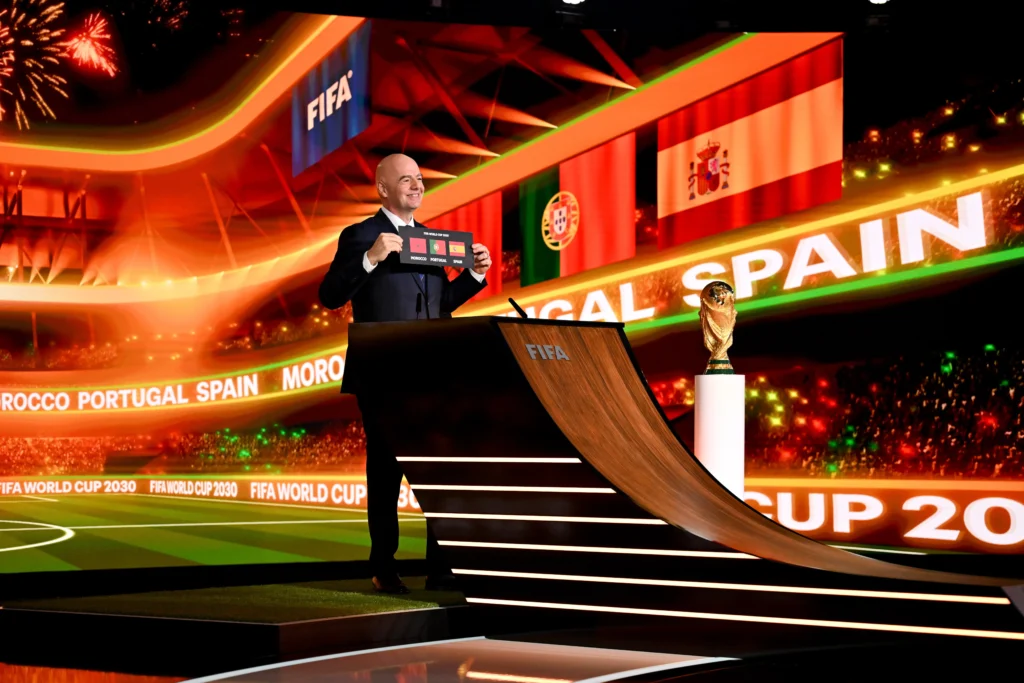
Observers have even begun comparing the current situation to the final months of former FIFA president Sepp Blatter’s administration, when increasing pressure from football associations eventually led to his resignation in 2015.
Should opposition continue to grow, some insiders believe Infantino could eventually face a formal attempt to remove him from office.
Under FIFA’s statutes, removing a sitting president is a lengthy but possible process.
At least one-fifth of FIFA’s member associations—a minimum of 43 national associations—must jointly request the convening of an Extraordinary FIFA Congress.
Once the meeting is held, any motion to remove the president requires an absolute majority of the voting members to pass. With FIFA currently consisting of 211 member associations, that would theoretically require at least 106 votes in favor of dismissal.
UEFA alone represents 55 member associations, meaning it could comfortably reach the threshold needed to request a special congress.
However, removing Infantino would require substantial support from other continental confederations, including Africa, Asia, South America, and CONCACAF.
That remains the greatest obstacle for any potential challenge.
One of Infantino’s greatest strengths throughout his presidency has been his support among smaller football nations.
Reports suggest many African associations continue backing him, largely because of increased FIFA development funding distributed during his administration.
Those votes have traditionally formed one of the strongest pillars of his political support.
South America’s position remains far less certain.
CONMEBOL has previously supported major structural changes to the World Cup, including the controversial proposal to expand the tournament to 64 teams.
Meanwhile, political uncertainty surrounding several football officials in the region has made predicting voting intentions increasingly difficult.
As discussions continue behind the scenes, 12B Sports observers believe the coming months could determine whether enough confederations unite to seriously challenge FIFA’s current leadership.
Should Infantino eventually leave office, several names have already begun circulating as possible successors.
Among the leading candidates reportedly being discussed is Victor Montagliani, the Canadian football administrator who currently serves as president of CONCACAF and FIFA Vice President.

His extensive experience within both regional and global football governance makes him a credible candidate if the presidency becomes vacant.
UEFA has also reportedly explored the possibility of encouraging Paris Saint-Germain president Nasser Al-Khelaifi to run for FIFA president.
However, Al-Khelaifi has previously stated publicly that he has no interest in seeking the position.
For now, Infantino remains in office, and no formal removal process has begun.
Nevertheless, with opposition continuing to grow and several powerful football organizations openly questioning his leadership, the coming months may prove to be among the most significant in FIFA’s modern political history.
As football’s governing body navigates this escalating dispute, 12B Sports fans around the world will be watching closely to see whether the controversy fades—or develops into an unprecedented leadership battle at the very top of world football.